23.11.07

Private Eye cartoon: Facebook schmacebook


This cartoon is in the current Private Eye. Like many magazines they carry a lot of cartoons that are sceptical about new technology. But despite the view taken in this cartoon, I'm no luddite. I do have both a Facebook and MySpace profile ... it's just that often I'm not sure why. I signed up for Facebook because I was invited to, now I keep getting endless emails saying someone wants to discuss favourite movies with me, or has thrown a virtual custard pie at me. I ignore these to such an extent that someone sent me an email saying "You have been invited to join The Group For People Who Join Facebook Then Don't Do Anything". Naturally, I did nothing.

6.11.07

Bonfire Night cartoon


From one of the local papers here in Kent. Hope you had a good one last night, if you took part. For any international readers who don't know what this is all about, it's a traditional thing ... families together, a bite to eat, a few fireworks, burning the effigy of a Catholic conspirator, that kind of thing ...

31.10.07

Reader's Digest cartoon: Funny bunnies


Here's a gag from the October Reader's Digest. I don't do that many cute animal cartoons, but they're usually popular so I suppose I should. Captionless gags are often popular too, I think because the reader sometimes has to work a bit harder to get the joke, so when they do it's rewarding. I personally find them more difficult to come up with though.

A cartoon batch one year on ...


While having a clearout of files on my computer, I found this collage from a year ago this week. The Wisenheimer, an American cartoonists' internet forum that I take part in has an occasional thread called "What's on your drawing board?" where people show their latest work. I had just put together a batch of cartoons to be sent out on-spec to magazines. So, as I didn't want to reveal the actual jokes, I just used excerpts from each cartoon. Some people put up low-res unreadable scans.

The thing that's of interest one year one, which illustrates the insanity of the gag-cartoon market, is that only one of these has so far sold! (Left hand column, one down, it was in Prospect magazine.) This, I should point out, is perfectly normal for freelance gag cartoonists! If you sell upwards of two or three out of ten that's a great result.

But all hope is not lost for the others. Some will be looked at, rejigged or reworded and sent out again. Others will go into semi-retirement as stock cartoons. Many find a home this way, though usually in not such high-profile places. For example, a gag I did about utility companies providing multiple services (it's funnier than it sounds, honest) was rejected by all the mags but has sold several times to, er, utility companies. So we keep churning them out ...

18.10.07

Cartoonists meet the public: Big Draw 2007

I took part in The Big Draw at Covent Garden at the weekend. The Big Draw is an annual, nationwide campaign to get people enthusiastic about all kinds of drawing.


A marquee was set aside specifically for cartooning. There were workshops on strips, caricatures etc. with cartoonists on hand to offer tips, advice and encouragement to those taking part.


Here's me doing a spot of “reverse caricaturing” (Thanks to John Stilgoe for the pic.) This is where people put their faces through a board, like the ones you see at the seaside, except it’s blank and the participants say what kind of body they’d like. Very popular with the kids: lots of fairies, pirates, princesses, animals and a couple of Bart Simpsons. I probably had to draw a few too many girls as butterflies than was strictly necessary. All good fun though. The whole event reminded you of how much people love cartoons – grown-ups as well as kids. I hope there were some art editors from magazines and newspapers taking note!

Like last year, there was a Battle of the Cartoonists, where four teams competed to produce a banner on the theme of “High Life, Low Life”. Again there were teams from Private Eye, The Guardian and The Independent, plus this year there was a team from the new Professional Cartoonists’ Organisation. The banners were put to the public vote, with those clever clogs from The Guardian, led by Steve Bell, winning again. There's more on the Battle at the PCO Blog

There are Big Draw events throughout the UK right now. See their website for details.

10.10.07

Caricaturist mystery: Who's Ronson?

A book dealer contacted me asking if I was in any way connected to the caricaturist who produced this:


I certainly wish I could draw hands as elegantly as that. Obviously it's not me, as this is from the 1930s! There is some similiarity in the signatures, but I think it looks more like "Ronson", with an elaborate "s", or it could be "Royson".


Google searches have failed to turn up any info on this artist, so if anyone knows anything about "Ronson" or "Royson", please let me know and I'll pass it on.

5.10.07

Smoking cartoon

In the UK the age at which you can legally buy cigarettes was raised this week from 16 to 18. Here's a cartoon I did to accompany a news story on this subject.


A cartoonist friend of mine mentioned in a recent letter to The Jester, the CCGB newsletter, that that there was once an agency that asked cartoonists to supply cartoons depicting smokers as happy folk enjoying a harmless pleasure. These were known as "Smokey Jokies" and the agency would place them in magazines and papers throughout Europe. This product placement system was funded by cigarette companies and would earn the cartoonist a bonus. This couldn't happen now, one would hope, and even if it still went on I'm pretty sure that this cartoon wouldn't be accepted!

3.10.07

Cartoon book: Laughing All Over the World


I have several cartoons in a new kids' joke and cartoon book which is out this month and is sold in aid of the Kings World Trust for Children. The Trust was founded in 1993 to provide a caring home, an education and skills training for orphan and homeless children in developing countries. Its work is focused in India, which has the largest percentage of orphan and homeless children in the world.

Children, celebrities, comedians and cartoonists from the UK and overseas have contributed rib-ticklers, one-liners, anecdotes and cartoons to the book. Most of my cartoons are animal gags. Here's one of them:


See more on this book at laughingallovertheworld.com

30.9.07

Cartoons: You love them!


There's no doubt that there are significantly fewer markets for on-spec gag cartoons these days, hence we all have to branch out into other areas. But it's good to see Reader's Digest keeping the faith.


On top of the usual selection of gags there's an extra section in this issue, which includes a couple of mine (above). The contents page reads: Cartoon Bonus: You love them. Here's more. Music to the ears of any cartoonist, so amen to that!

27.9.07

Comics Britannia, part 3

Here's the review of the third part of Comics Britannia, which I wrote earlier this week for the PCO blog.
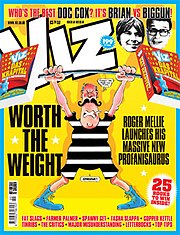

THE final part of BBC Four's Comics Britannia covered the period from the late 1970s when comics grew up. OK, maybe "grew up" is not the right phrase – especially as the programme opened with a look at Viz comic. Perhaps, "annoyed the grown-ups" is more appropriate, as this was when comics started to become grittier and more realistic, a world away from the Beano and the Dandy.

The documentary rightly asserted that although, on the face of it, Viz was just a downmarket rag packed with toilet humour and some creative swearing (Johnny Fartpants was looked at in some depth) its cultural significance cannot be underestimated. Comedian Frank Skinner argued that it was the first time that a type of humour experienced everyday in the schoolyard and in the pub broke into the mainstream.

This was made possible because Viz sprang not from the mainstream media but from the underground fanzine culture that sprang out of punk, and not from London but Newcastle. It was an authentic voice. Comedian Stewart Lee and others were called upon to read some of the Top Tips from the comic, laughter was mandatory. And with its non-PC characters such as Sid the Sexist and Millie Tant, Viz did not toe the line of the new politically correct comedy establishment. As Skinner commented, Viz "has a beautiful freedom about it".

Deftly pulling together some seemingly very different threads the programme moved on to Action comic which was around in the same late 70s period. The IPC comic was a very different animal to Viz, being a "serious" comic aimed at boys, but it was breaking similar taboos. It featured antiheroes rather than square-jawed heroes, and some quite violent storylines. Strips such as Look Out For Lefty, which covered football hooliganism and was a kind of dark twin to Roy of the Rovers, provoked the fury of the tabloid press. Action was withdrawn by IPC and later closed down.

Pat Mills, the man behind Action and a key figure in British comics, pointed out that it was effectively relaunched under the cloak of science-fiction, as 2000AD. They found they could get away with violent and challenging stories that reflected contemporary Britain ... if they were not set in contemporary Britain. Spanish artist Carlos Esquerra (who must have been a bit miffed to be given subtitles even though he was speaking English!) was on hand to draw Judge Dredd and talk about how his experience of growing up under Franco informed his depiction of the fascistic lawman.

From 2000AD we moved on to the career of one of its writers, and one of the most significant players in comics: Alan Moore. It's always a joy to see Moore on the telly, especially so soon after he popped up in Jonathan Ross's BBC Four documentary about reclusive Spider-Man artist Steve Ditko. We looked at Moore's V for Vendetta, created with David Lloyd, the story of Britain under a fascist dictatorship and inspired by the dark days of early 80s Thatcherism. We learned that it was very deliberately aimed at adults, with Moore and Lloyd eschewing Biff! Bang! Pow! sound effects and thought bubbles, and introducing a depth never before seen in comics.

The "British invasion", which saw UK comics writers and artists headhunted by the Americans, came next. This led to the classic Watchmen, created by Moore and Dave Gibbons, which imagined what superheroes would be like in the real world (the answer: fascist nutcases). Moore's reading of the Rorschach character was a joy, even if you had never imagined the creepy vigilante with a Northampton burr.

The final part of Comics Britannia was a good overview of comics' latter history, though there were some omissions. Where, for example, was Moore and Eddie Campbell's epic From Hell? But sometimes it's good to be left wanting more, or indeed wanting Moore. Someone should give that man his own chatshow.

Link: Comics Britannia

26.9.07

Prospect magazine cartoon: The cautious approach


Here's a cartoon from the new issue of Prospect. I am one for leaving the radio and a light on when leaving the house. People laugh, but then I have been burgled twice, though admittedly both times were when I lived in a rough area of Sunderland as a student and they were within six months of each other! Still, can't be too careful. Top tip: leave BBC Radio Four on, it sounds like people talking ...

Cartoonist grovels: Sory for teh typos

Writing a blog means that you don't have a proofreader, so for more than a week there was a post on this site that referred to a blog run by the "Professional Cartonists' Association". Well, first of all, it's an organisation rather than an association, and secondly, its members are involved in producing humorous drawings, not containers for orange juice.

To make amends, here's a link to the PCO's main website. Not a Tetrapak in sight. They have some fine cartoons on the site as you can see below ...

21.9.07

Comics Britannia, part 2

Here's the review of the second part of Comics Britannia, which I wrote earlier this week for the PCO blog.


THERE was a very different cast of characters for the second part of the Comics Britannia documentary, and not just on the page. Gone were the quiet, eccentric types such as Aardman's Nick Park and poet Michael Rosen, who reminisced about The Beano and The Dandy last week, and in came journalist Max Hastings and comedian Frank Skinner to talk about real boys' stuff ... war and football!

Just like in the comics the girls in the audience were given something to keep them quiet too, so cartoonist Posy Simmonds and writer Stella Duffy were there to talk about the stories of ballet, boys and boarding school. A Mel Gibson was on hand to talk about the days of inky fingers – she's a "comics historian", apparently.

Again Comics Britannia took a no-nonsense, chronological approach to telling its story. It picked the launch of the Eagle in 1950 as a starting point. I was amazed to learn that Dan Dare – Pilot of the future, started out, like the Eagle's creator Marcus Morris, as a man of the cloth. Not surprising really, as the comic was launched as a wholesome alternative to the imported American horror comics, such as Tales From the Crypt, that had been busy warping young minds at the time.

The programme was packed with such nuggets of trivia. Who knew that Jacqueline "Tracy Beaker" Wilson was once a DC Thomson employee and that her name inspired a new comic/magazine aimed at girls? Jackie, of course. Or that a young Gerald Scarfe won a drawing competition in the Eagle, with David Hockney as runner-up?

In fact, much of the documentary was a revelation to me because I spent my childhood immersed in humour comics, mainly The Beano, and didn't bother much with sport and war comics. I was amazed to find that pop fops Spandau Ballet once played for Roy of the Rovers – though this explained the signing of Shakin' Stevens in the Viz football spoof Billy the Fish (no doubt more on that in the final part of Comics Britannia next week).

Likewise, I wasn't too familiar with war characters such as Captain Hurricane. He was described here memorably by Frank Skinner as "a sort of muscular Duke of Edinburgh figure ... a racist term for every occasion". It was interesting to hear that Charley's War, a later war strip which dropped the gung-ho approach (no more "Eat lead, Fritz!" caricatures) and attempted to cover the horror and futility of conflict, had been influenced by the real emotions found in the stories of girls' struggles featured in Bunty and Tammy.

Another enjoyable and shamelessly nostalgic romp through the comics, then, but with a hint of sadness. We're told that 10 million comics a week were sold in 1973, but it's made very clear: those days have gone.

Link: Comics Britannia

14.9.07

Using cartoons: Excelente gag por el genial Royston Robertson

We've all done it. You have a moment of down time and, inevitably, the Devil makes work for idle hands. So you find yourself indulging in that sordid activity known as – whisper it – self-Googling. For a cartoonist this can throw up some interesting results, such as this (click image to enlarge):


Now I've no idea who this guy is, or why he's used one of my cartoons to illustrate his blog entry. But he's given me a credit and a link to my website, which helps Google rankings of course, so I'll turn a blind eye. Plus, according to the Altavista Babelfish translator, "el genial" translates as "the brilliant one". Flattery will get you everywhere.

But I would say to anyone thinking of lifting cartoons from this blog, or my website, please ask. If it's for any kind of for-profit site, there will of course be a charge. But if it's for a blog, like this one, I may just ask for a credit and a link to my website. Gracias y adiós.

11.9.07

Comics Britannia

I wrote this review of part one of the Comics Britannia documentary, which was on the BBC Four digital TV channel last night, for the Professional Cartoonists' Organisation blog.

VARIOUS bigwigs at the Beeb have suggested recently that BBCs Three and Four could be axed, in a cost-cutting move. The former is fine by me – there's only so many times you can watch Two Pints of Lager and a Packet of Crisps repeats – but on the evidence of Comics Britannia, we should get the placards out and start a "Save BBC Four" campaign right now.

The documentary was nothing groundbreaking, it was a straightforward, chronological, talking-heads history of British humour comics, but it was informative and intelligent and mercifully free of the kind of dumbed-down script and constant re-capping that afflict so many contemporary documentaries (see BBC Two's British Film Forever series).

The first of a three-parter (the others are on boys and girls comics, and the grittier work that emerged in the 1970s and led to the graphic novel boom) it was a chronological potted history from the birth of The Dandy in 1937 to the present day. It began with a serious misstep that some commentators have already noted, the claim that "speech balloons were a key innovation" of The Dandy – in fact they'd been around for hundreds of years – but it soon redeemed itself as it took us on a nostalgic journey through the story of DC Thomson's iconic Beano and later IPC rivals such as Whizzer and Chips.

Issues that arise out of a study of comics, such as the early racism, their role in brightening up a grim postwar Britain, and the debate over whether comics are "bad" for you, were discussed intelligently by the likes of Guardian cartoonist Steve Bell, poet Michael Rosen, Aardman animator Nick Park and a whole roster of cartoonists and writers from the glory days of comics.

What was particularly satisfying, from this cartoonist's point of view, was that the documentary, narrated by comedian Armando Iannucci, stated that its mission was to uncover the artists behind the strip and give them due recognition. And it did just that. It was a joy to hear the names of Dudley Watkins, David Law and Ken Reid mentioned on TV and particularly great to see the genius that is Leo "Bash Street Kids" Baxendale being interviewed. It was also great to see artwork presented in all its glory, so close you could see the pencil marks.

I'm looking forward very much to parts two and three, as well as to the other shows in BBC Four's comics season (see link below for details). In the meantime, I've got placards to write.

Link: Comics Britannia

6.9.07

Original cartoons


I recently sold the original of this early cartoon of mine which was published in Punch in 1998. If I was to compile a top ten of my most popular cartoons, based on comments I've received about them over the years, this one would certainly be in there. I still think Intense Patio would be a good band name.

Selling original artwork is always satisfying because it's nice to know that someone liked a cartoon enough to consider putting it on their wall, or giving it as a gift. Plus it reminds me that all those drawings taking up space on my shelves are potentially worth something! So it's important for cartoonists to hang on to their originals.

I'm told that people who buy originals like to see all the smudges, Tipp-ex, pencil marks, creases in the paper etc. I'm relying on that fact! If you're interested in buying original artwork, email me for prices: roystonrobertson at gmail dot com ... excuse the written out address but I'm trying to prevent any more penis enlargement emails.

30.8.07

Reader's Digest cartoon: The family way


I find my best cartoons are the ones inspired by real-life events. I recently met a married couple who had a young child plus a boy and a girl who were from each of their previous marriages. I was finding it hard to remember which kid was the offspring of which parent when it occurred to me ... what if the parents couldn't keep track? Hey, cartoon idea! This gag is in the August issue of Reader's Digest. By the way, no comment is intended on what the media has taken to calling "blended" families. It's just a joke.

26.8.07

Birthday cartoon: The Big Four Oh-No


This is a cartoon I drew for an invitation to a 40th birthday party. It was easy for me to think of an idea for this as I'm reaching that milestone myself in a few months. I like to think I look better than the guy in the cartoon though ...

17.8.07

Private Eye cartoon: Summer at last!


Private Eye magazine took this cartoon some months ago. I assume that the reason it only appeared this week is that it kind of depends on fine weather! It would have looked a bit silly if they had run the cartoon amid all the gags about rain and floods. Obviously I knew it was a non-topical joke when I sent it, therefore it would have a longer shelf-life, but for a while it became kind of anti-topical. Anyway, we've had some fine weather for a short while at least – been out enjoying it myself today – so finally it gets its, er, moment in the sun.

I regularly draw cartoons for the Law Society's Gazette, so I can draw barristers, judges etc with my eyes closed.

13.8.07

Website cartoons: Pop Idol for cartoonists

The cartoon section of the Reader's Digest (US) website appears to have been revamped, with lots of great cartoons added and even biographies of some of the regular contributors. It's good too see a magazine that values cartoons in this way.

One of my cartoons is on there, in the "Surprise Me!" category, and I was a bit taken aback to see that the gags are rated by the public. It's like a cartoon version of Pop Idol or The X-Factor! Still, four out of five ain't too shabby (click image to enlarge) ...